BARBARA ZECCHI

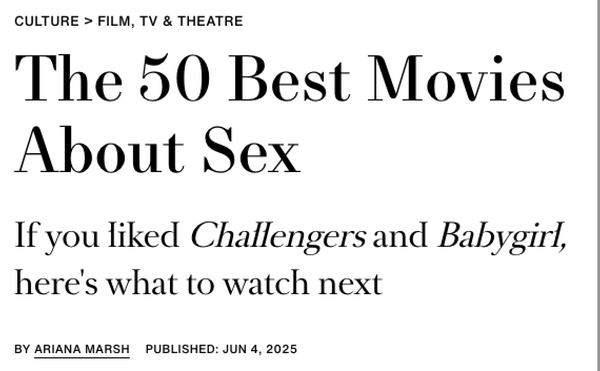


Full Interview for Harper’s Bazaar:
1) How has the portrayal of sex and sensuality in films changed over the decades?
The representation of sex and sensuality in cinema has undergone dramatic shifts—from the relatively unregulated eroticism of early silent films (think of Ecstasy [1933] with Hedy Lamarr) to the rigid restrictions imposed by the Hays Code (1934-1968), which famously mandated separate beds even for married couples on screen, as in I Love Lucy. While the sexual revolution of the 1960s began to challenge traditional boundaries, it is more recently—with an increasing presence of women and queer creators behind the camera—that depictions of sexuality have started to diversify. These portrayals challenge the long-dominant heteronormative male gaze, where sex was often reduced to a man penetrating a woman, capped with a synchronous orgasm. Now, there’s a slow but visible shift toward more inclusive intersections and expressions of desire that don’t follow conventional scripts. Still, many gaps remain. We’re moving forward, but often only one axis of identity at a time is explored. In other words, we might see more non-white characters, more same-sex couples, or more disabled people depicted in sexual contexts—but rarely are these identities combined or fully integrated. Usually, films focus on only one of these aspects at a time. That is, we’re not yet seeing enough stories that show how race, gender, disability, age, etc. intersect and shape people’s experiences—especially when it comes to desire and intimacy. As a result, truly intersectional representation is still rare.
Also, one still striking absence is the portrayal of older women’s sexuality, particularly in relationships with younger men. While such pairings have appeared on screen, they are often framed through the lens of the monstrous feminine (as in The Graduate, where the older woman is cast as a predatory nymphomaniac) or as tragic, pitiable figures (like in Roger Michell’s The Mother). These narratives tend to pathologize female desire rather than normalize it. A more recent film like Babygirl (Halina Reijn, 2024), featuring Nicole Kidman, gestures toward a more complex and less judgmental depiction, but it remains an exception.
2) When you think of what makes a film standout in regard to its portrayal or exploration of sex and sensuality, what comes to mind?
What makes a film stand out in its portrayal of sex and sensuality is not simply its level of explicitness, but the kind of gaze it enacts—and whose desire it centers. I’m especially drawn to films that foreground female subjectivity, not only representing women as desiring subjects but also allowing female creators to shape the erotic imagination behind the camera. In this context, the classic distinction between erotica and pornography becomes increasingly unstable. As Ruby Rich famously noted, the difference often lies less in the image itself than in who is watching the film and interpreting it: “If I like it, it’s erotic; if you like it, it’s pornographic.” Too often, scholars like Diana Russell’s assume that degradation is embedded in the text, when in fact meaning is co-created through intention and interpretation.
When women craft these films, they (generally) offer alternatives to the dominant sexual economy—resisting the phallocentric model of male pleasure (i.e. penetration) and replacing it with affective, relational, and “clitoral” modes of desire. A film stands out when it expands the erotic imaginary to include bodies and forms of pleasure often excluded or devalued in mainstream cinema—when sensuality is not bound to youth or conventional beauty. When so-called “imperfect” (older, disabled) bodies are portrayed not as abject or pitiful, but as sites of desire. When eroticism disrupts not only heteronormativity, but also the visual grammar of scopophilia itself. When the film doesn’t just ask us to look—but to imagine differently.
3) How do accurate portrayals of sex and sensuality in films help people better understand sex—how to enjoy it, what is and is not appropriate, how to navigate kinks or fist-time experiences, etc.—in real life? This is an excellent question. Cinema has the power not just to shape our understanding of sex, but to normalize certain behaviors—sometimes dangerously so. Too often, films have romanticized or eroticized acts that are, in reality, violations of consent. Rape is frequently portrayed as seduction, persistence as passion, and women's initial refusals as mere hurdles to be overcome. In this way, cinema has historically played a role in legitimizing and naturalizing sexual violence.
Realistic portrayals of sex remain rare in mainstream cinema: safe sex is seldom shown, menstruation is virtually invisible, and consent is often ambiguous. Dominant heteronormative scripts reduce sex to penetration and synchronized orgasm, choreographed above all for the male gaze. As we argue in my co-edited volume on gender-based violence (Routledge), such representations not only obscure harm but actively reinforce patriarchal norms. Accurate portrayals of sex and sensuality in film help expand our understanding of what intimacy can look and feel like—beyond the narrow scripts we’re so often shown. I’m especially moved by scenes where sex is mutual, playful, and grounded in real pleasure, where connection is expressed through unexpected acts: sharing a piece of chocolate, bathing a sick partner, tending to a lover’s wound. These portrayals provide compelling alternatives to dominant norms, encouraging viewers to envision sex as a multisensory experience—not limited to penis-vaginal penetration and orgasm alone.
4) Can you please recommend 5-10 films we should include on this list with a sentence about why for each? Feel free to choose films already in the post or propose new suggestions.
1) In the Mood for Love (Wong Kar Wai, 2000)
— In my opinion the best example of erotic tension and restraint, where every glance, brush, and unfulfilled touch becomes charged with longing.
2) Poetry (Lee Chang-dong, 2010)
— Explores aging, desire, and ethical responsibility with delicacy and beauty. The film includes a tender and complex sexual encounter between the older protagonist and a disabled man, challenging conventional depictions of intimacy.
3) My Life Without Me (Isabel Coixet, 2003)
— A young woman facing terminal illness reclaims her body and desire on her own terms. Sensuality emerges not only through sex but through small, tactile pleasures—eating pie, walking barefoot on grass, feeling alive.
4) Oasis (Lee Chang-dong, 2002)
— A bold and tender portrayal of desire between two disabled people, Oasis challenges cinematic conventions of eroticism and affirms that all bodies are capable of love, pleasure, and connection.
5) Carol (Todd Haynes, 2015)
— One of the most sensuous lesbian love stories on screen, where touch, glances, and silences carry erotic charge and emotional gravity.
6) The English Patient (Anthony Minghella, 1996)
— A deeply evocative portrayal of love and desire unfolding amid the ravages of war, where intimate scenes emphasize tactile pleasure and emotional delicacy.
7) The Constant Gardener (Fernando Meirelles, 2005)
— The chemistry between the protagonists is expressed with playful warmth and laughter, making their intimacy feel authentic and mutual.
8) Besieged (Bernardo Bertolucci, 1998)
—A subtle and intense portrait of desire, where passion unfolds through gestures of care and unspoken longing, always grounded in deep mutual respect.
9) Life Begins Today (La vida empieza hoy) (Laura Mañá, 2010)
— A smart, provocative comedy where older adults in a sex-ed class rediscover sensuality, desire, and personal agency.
10) El pájaro de la felicidad (Pilar Miró, 1993)
— Centers the desire of a middle-aged woman, challenging normative ideals of beauty and offering an emotionally rich vision of female eroticism, with moments of subtle and beautiful homoeroticism.
11) Titane (Julia Ducournau, 2021)
— A film that confronts the fluidity of desire and the body’s capacity for transformation, breaking down conventional boundaries around gender and blending human and machine in an unsettling expression of eroticism.